
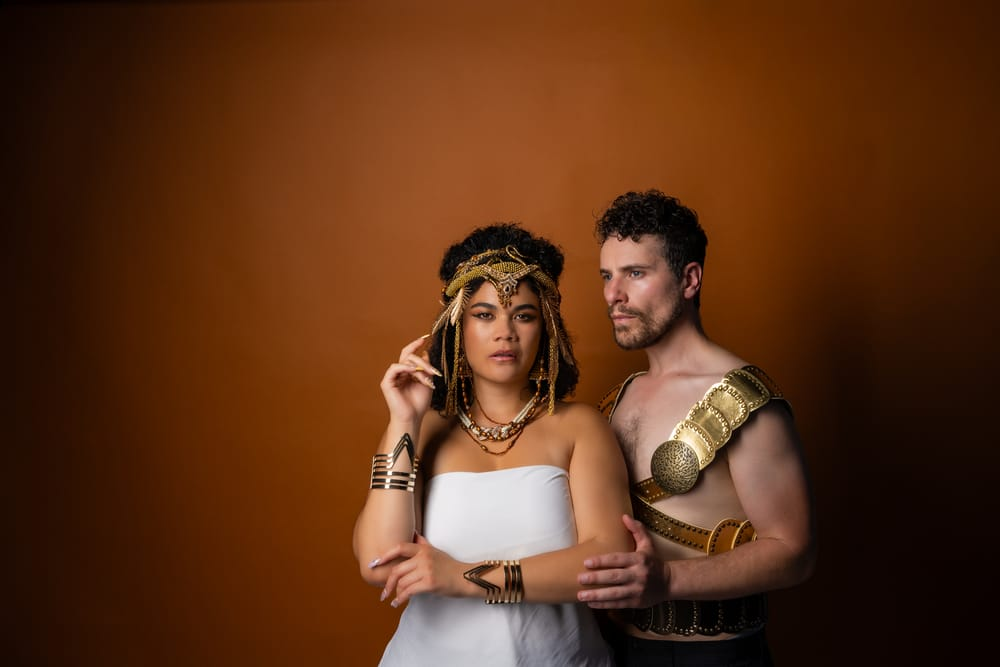
Photo Credit: Nick Mick Pics (@nickmickpics)
Playing as part of Melbourne Shakespeare Company’s MSC Studio season at 45 downstairs, Cleopatra and Antony focuses in on framing Cleopatra in a fast paced staging that unpacks the play even as the characters barrel to its tragic end.
Director Sonya Suares’ adaptation is both quick and exciting and deeply immersed in speaking directly to the history that produced the play. While one of Shakespeare’s longest plays, the script is neatly edited down to a 90 minute political thriller, being quicker and shorter than many productions of more widely staged tragedies like Macbeth. Antony and Cleopatra being one of the plays least often staged locally also makes the edit less noticeable, especially considering for many audience members it could likely be their first introduction to the play. While the MSC Studio shows have their own unique feel to their outdoor theatre seasons, it brings the same vibrancy and immediacy that has come to define the company.
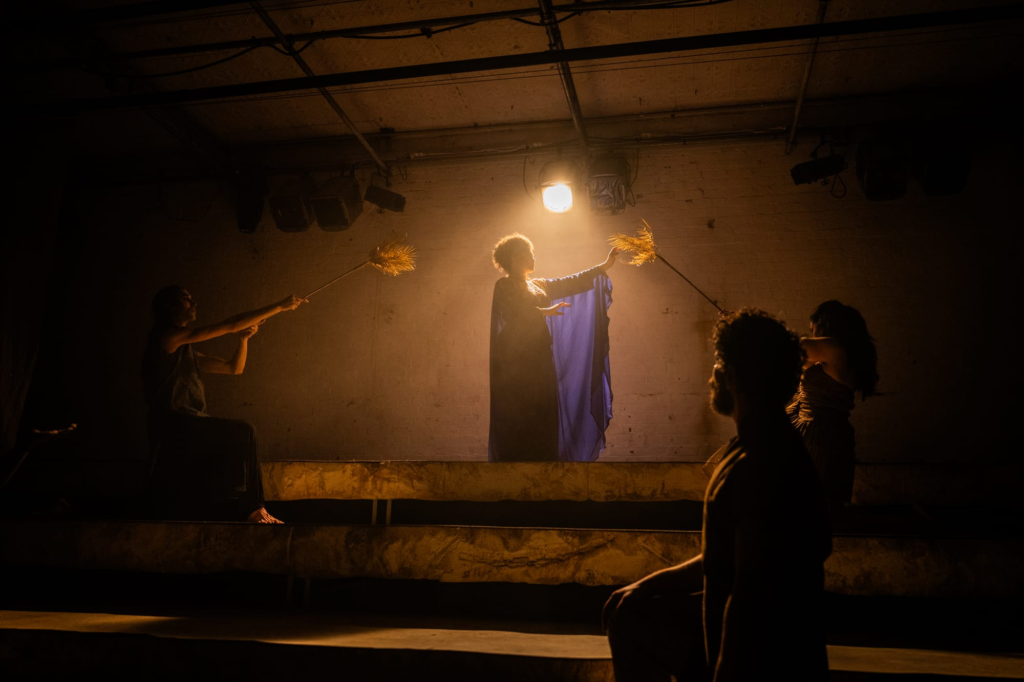
Eloise Kent’s set design translates across the play’s dozens of locations, with the layers of rough stonework resembling both ancient ruins and a rocky cliff-face. The sail-like curtains framing the stage also move being a relaxing villa and the thrashing ships of a battlefield with evocative ease.Rob Sowinski’s lighting bathes the stage in golds and icy blues, and particularly shines in the epilogue.
Across Samantha Hastings’s earth-toned costume design, Antony’s more fitted wardrobe makes him feel much more at home with the similarly attired Egyptian court than the toga-inspired Romans, especially the red of Octavius. Blue being confined to Cleopatra’s court – particularly Cleopatra herself, the soothsayer, and the narrator Charmian – links the three in a way that feels not only visually distinct but makes Cleopatra also look almost supernatural in a similar way. And Cleopatra’s snake hairpiece doubles as both a subtle piece of symbolism and a unique approach to bringing the play to a close.
Akina Edmond’s Cleopatra rises to the challenge of embodying a larger than life figure; even in more relaxed moments, within the playfulness and ease there’s a sense that it comes from confidence in her own power. With the emphasis on how closely the pharaohs were seen to the gods, she effortlessly navigates the tricky space of a character that is both deeply human and has been raised to be viewed as a god on earth.
The additional narration also emphasis major historical elements less focused on in the playscript, most notably that Cleopatra’s son with Julius Caesar, Caesarion, could be seen as dual heir to both Egypt and Rome, and that despite Octavius’ talk of mercy Caesarion barely outlives his mother. It highlights both Cleopatra’s ambition and her fight for the survival of both her people and her family in a battle of empires. The reordered final scene is particularly powerful, highlighting a woman that has created a legacy that’s endured two thousand years after her death.
Louis Lucente’s Antony is both powerful and conflicted. The additional narration around the theory of Mark Antony following what Cleopatra had designed as a tactical retreat brings additional focus to the character’s contrast between the Julius Caesar and Antony and Cleopatra play scripts. While still in many ways a godlike figure, in contrast to the charismatic eulogies of the earlier play, the later Antony can feel less strategic – or at least less successful, with many of his decisions causing further downward spirals. So the happiness he shows alongside his lover feels even more like respite compared to seeming exhausted by years of political gameplay in Rome – while in many ways an older Romeo and Juliet, it highlights a tragedy built from not only impulse but a buildup of actions and choices over a lifetime.
Acting as both narrator and in-universe dramaturg, Tsungirai Wachenuka is a constant watchful presence as Charmian, one of Cleopatra’s attendants who watches their legacy both within the story and the centuries beyond it. While there’s a couple of early moments of confusion with scenes in Egypt where Charmian is present as a narrator but not a present character, her keen gaze is most powerfully felt in scenes where Cleopatra her being talked about by others – even while dismissed across the sea by people fighting her, she is witnessed by one who knew her as a person. Many of the staging’s insights come from her, highlighting both the personal aspects and the sheer scale of the stakes.
With a cast of 13 tasked with bringing to life a story that includes the 100,000+ combatant Battle of Actium, the ensemble and movement director Tom Royce-Hampton are able to compelling convey the scope of the narrative. Damon Baudin stands out as the Roman emperor Octavius, standing in the shadow of his adoptive father Julius Caesar and bringing a weight to the role.
Both action packed and thoughtful, Melbourne Shakespeare Company’s Cleopatra and Antony is a powerful, compelling staging of a rarely seen show.